Spread over
a vast area
of 411 acres,
the University
has an exceptionally
beautiful
and picturesque
campus.
The lush
green lawns
adorned
with beautiful
fountains
of the British
times and
the majestic
building
of the University
are a constant
source of
attraction
to the aesthetically
oriented
people of
Pune, filmmakers,
musicians
and celebrities.
The
University
campus is
covered
with a large
number of
age - old
trees,
which provide
shade and
beauty,
and the
peaceful
surrounding
make for
a very invigorating
environment
for serious
studies
and research
The Main
Building
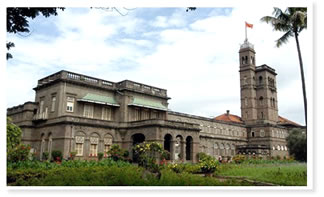 Savitribai
Phule Pune
University
is symbolically
identified
with the
Main Building,
it is a
monumental
building
with a beautiful
architecture,
and its
tower project
high in
to the sky
bearing
the flag
of the University.
The office
of the Vice-Chancellor,
Dean's Chambers
and Records
Section
are located
in the Main
Building.
Meeting
of various
academic
bodies are
conducted
in the four
prestigious
halls of
the Main
Building
Viz., Yashwantrao
Chavan Sabhagriha,
Sant Dnyaneshwar
Sabhagriha,
Shivaji
Sabhagriha
and the
Sant Gadge
Maharaj
Sabhagriha.
Savitribai
Phule Pune
University
is symbolically
identified
with the
Main Building,
it is a
monumental
building
with a beautiful
architecture,
and its
tower project
high in
to the sky
bearing
the flag
of the University.
The office
of the Vice-Chancellor,
Dean's Chambers
and Records
Section
are located
in the Main
Building.
Meeting
of various
academic
bodies are
conducted
in the four
prestigious
halls of
the Main
Building
Viz., Yashwantrao
Chavan Sabhagriha,
Sant Dnyaneshwar
Sabhagriha,
Shivaji
Sabhagriha
and the
Sant Gadge
Maharaj
Sabhagriha.
Thus Goes
the Legend
The
lofty Main
Building
of the Savitribai
Phule Pune
University
was once
the residence
of the governors
of Bombay
in the days
of the British
Raj.
It was built
in 1864
when Sir
Bartle Frere
was the
Governor.
Designed
by James
Trubshawe,
the magnificent
edifice
was built
in Ganeshkhind,
on the outskirts
of what
was then
called Poona.
Architecturally,
it defies
classification
though its
spiritual
antecedents
are Italian
and the
80 feet
flag tower
has been
described
as an 'Victorian
rendering
of an Italian
campanile'.
The building
was inspired
by Prince
Albert's
Osborne
House on
the Isle
of Wight.
The
cost of
residence
was Sterling
Pound 175'000
to build,
nearly six
times the
amount raised
by the sale
of the Governor's
previous
residence.
The building
of such
a palatial
house in
the aftermath
of the cotton
crash in
Bombay was
severely
criticized
and referred
by the British
Parliament
as 'a typical
instance
of the extravagance
and insubordination
of the Governors
of Bombay'.
Sir Frere
defended
his action
staunchly,
the house
was not
habitable
by the time
he left
India in
1867. His
successor,
Sir Seymour
FitzGerald
carried
out the
furnishing
and decoration,
and he in
turn was
criticized
for being
extravagant,
especially
for the
sterling
pound 500
chandelier
in the ballroom-which
still sparkles,
adding to
the grandeur
of the Ballroom!
Currently
Work is
on to restore
it to its
original
glory.